In the demanding world of today's professional drifting, victory is not merely solely a product of sheer engine power or behind-the-wheel courage. Instead, it has evolved into a complex discipline which requires a meticulous blend of choosing a proven chassis, equipping it with the highest-quality drift-spec hardware, and, most importantly, understanding its real-time behavior on the circuit through cutting-edge vehicle dynamics analysis tools. This comprehensive guide will serve as your roadmap from the initial idea of a project car all the way to the final telemetry-optimized tweaks that elevate a strong vehicle into a repeatable winner. We will delve deep into the precise engineering of chassis dynamics adjustment, illustrating how a advanced drift tuning app like a dedicated telemetry system eliminates assumptions and offers unmatched visibility into your vehicle's real-world performance.
The bedrock of any great drift car is, without question, the platform itself. Certain vehicles have attained renowned reputation within the international drifting scene due to their inherent balance, durable construction, and the immense availability of performance components available. Choosing the optimal car is the initial and most significant decision a driver will make. To illustrate, the BMW E36 is universally acknowledged as perhaps the the best balanced drift cars of the modern era. Its near-perfect evenly distributed mass, combined with a RWD configuration and robust straight-six motors, establishes a car that is simultaneously accessible for newcomers and highly capable in the control of a professional driver. The evolution of this concept, the BMW E46 platform, improves on these strengths with a even more refined frame, increased stance for enhanced high-speed stability, and yet more turning capability straight from the factory. Another dominant option in the top-level arena is the C6 generation Corvette.
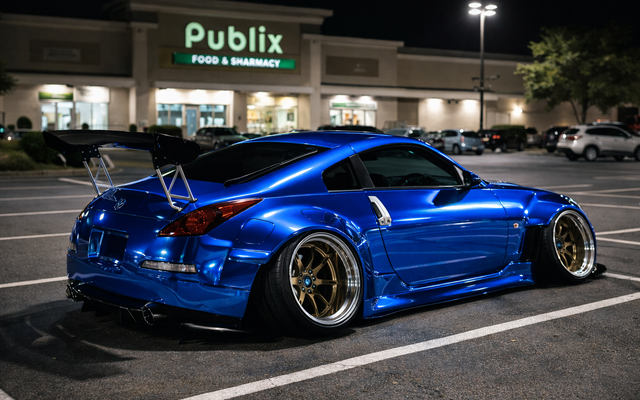
This muscle-derived sports car brings a particular array of strengths to the sideways discipline, featuring a lightweight aluminum structure, a backwards-positioned transaxle that contributes to an perfect front-to-rear mass ratio, and the immense thrust of a large-displacement LS V8 motor. This combination makes it an utter monster on track, designed of starting and holding long slides with seemingly minimal application of power. For builders seeking remarkable bang-for-the-buck, the Nissan Z33 stands out as a top-tier choice. It is delivered from the factory with a stiff body structure, a competent OEM locking differential, and the free-revving V6 engine that provides plenty of performance for mastering and advancing in the activity. Its successor, the Nissan 370Z, offers further advancements in chassis stiffness, steering geometry, and outright powerplant power, solidifying its position as a favorite pick among professional drivers. Other historic cars that warrant mention are the lightweight unique FC generation RX-7, the ubiquitous Nissan S13, the torque-rich Ford SN95, the electronic-equipped E90 3 Series, and the compact yet incredibly engaging and teachable MX-5 Miata. All of these platforms provides a different palette of characteristics, difficulties, and potentials, but they all have in common the fundamental ingredients required to be transformed into a competitive sliding vehicle.
However, selecting the optimal chassis is just the starting point. To access the true potential of every of these machines, major modifications to the steering and suspension systems are absolutely essential. This is where the world of specialist tuning components becomes critical importance. The one most impactful improvement for a serious drift car is the fitting of a maximum-angle drift angle kit. These advanced kits, for example those developed by performance brands like SLR Speed, are designed to dramatically enhance the car's possible turning lock. A OEM road car is severely limited in how far its steering tires can turn, a engineering trade-off for public road use. In sliding, conversely, extreme steering input is continuously necessary to control and hold a drift. An angle kit replaces the factory steering knuckles, rod ends, and often suspension arms with components that allow the steered wheels to attain steering lock beyond 70 or even 80 °, as opposed to a normal OEM angle of around 40 to 50 degrees.
This immensely expanded lock provides the operator with significantly more authority during a slide, allowing it to be much simpler to initiate a slide, maintain it through a long turn, and transition seamlessly from one angle to another. The contrast in drivability is absolutely revolutionary. Combined with a properly specified steering kit is the every bit as essential modification to the chassis's damping system. Store-bought or including expensive sport dampers are just not engineered for the specific and harsh needs of drifting. A purpose-built set of adjustable dampers is of utmost importance. These specific suspension components incorporate specific valving and spring strength that are tuned for the violent weight transfer that is characteristic of aggressive driving. When a driver initiates a angle, the car's mass is thrown forcefully to the outer of the corner. Proper competition dampers control this transfer in a consistent manner, allowing the chassis to settle rapidly and giving the pilot clear feel through the controls and driver's seat. They also provide accurate adjustment of ground clearance, damping firmness, and cross-weight, which are all fundamental parts of optimizing the vehicle's handling to a particular circuit or competition approach. As a system, a top-tier drift angle kit and a correctly selected system of performance adjustable dampers form the absolute physical base upon which all future tuning is built.
Once the core parts is fitted, the following essential phase in the development is the precise adjustment of the chassis's alignment. This is the world of chassis dynamics adjustment, a methodology that can feel overwhelmingly complex to the newcomer but is, in practice, the key to turning a assembly of fast pieces into a unified and consistent whole. The most critical parameter of alignment for oversteer is definitely camber. Camber is the tilt of the rim relative to the perfectly straight line when viewed from the forward of the chassis. If the top of the wheel is tilted inward, this is known as negative camber. For drifting, inward-leaning wheels on the front axle wheels is generally used and is regarded as essential. The reason is fundamentally tied to physics.
When a vehicle is going around a bend at limit angles, the frame rolls toward the outer of the turn. This chassis roll makes the outer front wheel to reduce its best contact patch with the asphalt. By applying an inward tilt, the wheel is pre-tilted to counteract this tilt. As the car leans into the bend, the outside front tire becomes more upright with the asphalt, increasing its traction at the precise point when it is needed most for directional command. Commonly, front axle angles for a serious drift machine fall between approximately -3 degrees to as high as -5 degrees or even more, contingent on the details of the car setup, compound type, and operator feel. The back wheels also use inward lean, but the values are typically more modest and more nuanced than the front axle. Overly aggressive negative camber at the back can make the car extremely prone to oversteer and difficult to control on power application, as it reduces the effective tire footprint of the driven tires during forward power delivery. Therefore, rear axle adjustments are frequently in the vicinity of -1 degree to -3 degrees, achieving a careful compromise between offering adequate side traction to help in entering and holding the angle while still preserving usable grip for exiting the bend. camber angle is only one component of the broader alignment picture, which also involves toe setting, caster, and bump steer adjustment.
Toe is the angle of the wheels as seen from above. Inward toe means the leading edges of the tires are nearer together than the trailing edges, while toe-out means the converse. For sliding, a modest amount of front toe out is frequently employed to sharpen the initial response steering reaction, making the vehicle feel more agile and ready to start a drift. Rear axle toe is generally set to neutral or a incredibly small amount of inward toe to promote predictability under throttle. self-centering is the frontwards or aft inclination of the steering axis when observed from the side-on of the chassis. Positive caster enhances feedback and high-velocity confidence, and it also increases camber increase during steering, which is extremely advantageous. Adjusting these values is a intricate interplay where a adjustment to a single setting can and often will affect the other settings. The traditional approach for tuning a chassis's alignment for competition has historically been a tedious affair of guesswork and adjustment. A tuner or team would apply a adjustment based on experience, drive the vehicle on track, use the operator's subjective feel and feedback, and then make a further change. This loop would repeat over and over until the chassis felt "good" or the allotted track period ran out. This methodology is not just exceptionally wasteful in terms of time and resources, but it is furthermore fundamentally imprecise.
Human perception is a notoriously inconsistent measurement tool, influenced by many elements such as fatigue, evolving track surfaces, temperature, and just the mood of the driver on that specific run. What feels "oversteery" on one run might feel "understeery" on the next lap, leading to confusing data and counterproductive tweaks. This traditional limitation in chassis setup is exactly where modern engineering tools has stepped in to revolutionize the process.
The rise and adoption of specialized drift telemetry software has ushered in a new age for building and refining professional sliding vehicles. These platforms, represented by innovative products like data acquisition tools, operate by directly capturing the real-time physical behavior of the car as it is piloted on the circuit. Unlike relying on subjective feedback, these tools collect objective information on essential factors such as suspension travel, individual tire rotation, G-force loading, wheel angle, and driver input position. This acquired information flow is then analyzed by powerful software that can plot and decode the data in a actionable way. For the first time, drivers and builders can see precisely what the chassis is performing at any given moment of a slide. This ability changes the whole chassis setup workflow. Think about the specific challenge of dialing in the front axle camber for a particular vehicle. Rather than making a adjustment from -3 degrees to -3.5 degrees and then driving multiple laps to try and "feel" a difference, a telemetry system can deliver instant and definitive feedback. The application can show in a chart how the wheel's grip is acting during the most important stages of a angle: turn-in, holding the angle, and changing direction. It can show if the existing angle is enabling the loaded tire to achieve maximum contact or if the compound is overloaded on its external shoulder.
The tool can after analysis make data-driven recommendations for adjustment. Perhaps the information reveals that the tire is even overworking its edge at -3.5 degrees of negative camber, implying that an increase to inward lean, say -4 degrees, might be warranted. Alternatively, the data might reveal that the tread is not coming up to optimal operating temp or that the inner edge is wearing excessively, which could point to that there is too much inward lean and a modest reduction back to -3.2 degrees would be better optimal. This degree of granularity and useful insight was literally unimaginable in the days of exclusively manual adjustment.
The effect of using a advanced suspension tuning tool reaches well beyond only setting camber angles. It serves as an essential coilover setup tips that is customized to your specific chassis. When adjusting the rebound and compression values on your suspension, instead of relying on imprecise tips or mimicking another car's numbers, you can use the telemetry to see how the car is performing in reaction to your changes. The application can graph the suspension travel path over a section of track, highlighting if the shocks are drift angle kits controlling the body movement effectively or if they are allowing the car to become unsettled excessively after a flick. It can aid in pinpointing issues like bottoming out or excessive extension, permitting you to apply educated decisions to helper springs, damping settings, or stance. This process applies just as well to the detailed art of car alignment tuning. Beyond camber, the tool can give analysis into how modifications to toe settings and caster are influencing the car's balance during various maneuvers of a slide. For example, it can assist you to ascertain the optimal amount of front axle negative toe for your individual steering rack setup and piloting technique by measuring the response time of initial reaction and the consistency of the car at full steering angle. This makes the tool an exceptionally powerful vehicle car suspension tuning dynamics manual that is dynamically calibrated by the real-world performance of your own vehicle on the circuit. It elevates the entire project from a mysterious craft into a repeatable optimization process.
Moreover, the utility of a tool like GripDial is not at all confined to experienced engineers with vast funding. For the amateur enthusiast, it serves as an incredible force multiplier. It effectively provides the builder with the knowledge of a expert suspension specialist without requiring the corresponding cost. It accelerates the learning curve by giving unambiguous solutions to problems that would traditionally take years of experience to understand. A driver can understand how their particular car behaves to various inputs, developing a deeper understanding of car control in the journey. It furthermore democratizes advanced suspension engineering principles, permitting all drivers with the ambition to refine their machine to achieve it in a structured and productive manner. This is especially valuable in a discipline like drifting, where setup expertise has historically been a tightly held advantage among professional teams. In the modern era, that power can be in the toolkit of any serious builder.
In conclusion, the journey to engineering and optimizing the ultimate competitive drift machine is a comprehensive mission that smoothly combines proven mechanical principles with cutting-edge data solutions. It starts with the wise choice of a legendary chassis, then enhanced by the installation of non-negotiable performance hardware like drift-spec steering angle kits and expertly valved competition adjustable dampers. The journey then advances into the detailed phase of chassis dynamics adjustment, where settings like negative camber, toe setting, and caster are meticulously adjusted to complement the car's new geometry and the driver's personal needs. The final step, and what genuinely separates the today's methodology from the old ways, is the integration of a sophisticated suspension tuning application. This tool removes the guesswork and inefficiency of solely seat-of-the-pants tuning by giving objective, real-time data on how the vehicle is actually behaving. It functions as an indispensable suspension tuning tool, a definitive drift suspension tuning guide, and a all-in-one chassis development system. In unison, this integrated approach guarantees that every component of the competition vehicle—from the selection of the platform to the final tweak on the coilover—is optimized for maximum success on the competition venue. It embodies the complete progression of the sport drift angle kits of oversteer driving, merging raw pilot talent with surgical suspension engineering to build the most competitive vehicles imaginable.